
A few years ago, I was sitting in a classroom discussion where two people strongly disagreed about what makes a society powerful. One person said it was money. Another argued that political control mattered more. As the conversation continued, I realized there was another kind of power that neither of us had considered properly.
It was the power to influence what people think is normal.
That idea eventually led me to the word hegemony.
At first, hegemony sounded like one of those complicated academic terms that belonged in a political science textbook. But once I understood the basic idea, I started noticing it everywhere. In politics, culture, education, media, business, and even everyday conversations, certain ideas become so dominant that we stop questioning them.
So, what exactly is hegemony, and why does it matter?
What Is Hegemony?
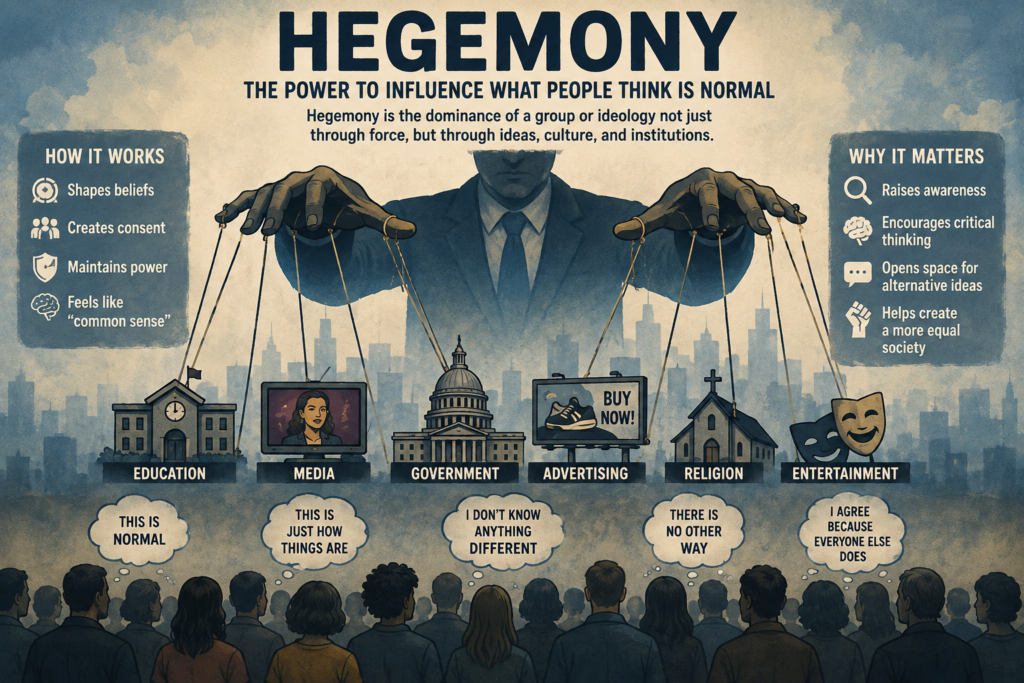
In simple terms, hegemony refers to the dominance or influence of one group over others, especially when that influence is maintained not only through direct force but also through ideas, beliefs, culture, and social expectations.
The important part is that hegemony does not always look like obvious control.
Imagine a society where most people automatically accept that one particular lifestyle is the “right” way to live. Nobody is forcing them to believe it. They simply grow up hearing the same message from their families, schools, entertainment, advertising, and social institutions.
Over time, that belief can feel completely natural.
This is where hegemony becomes interesting.
It can shape people’s understanding of what is normal without requiring someone to stand over them and give orders.
Where Did the Idea of Hegemony Come From?
The word has a long history and originally comes from an ancient Greek term connected with leadership or command.
However, the concept became especially influential through the work of Italian philosopher and political thinker Antonio Gramsci.
Gramsci developed the idea of cultural hegemony, which explains how dominant groups can maintain influence by shaping culture and common beliefs.
Instead of relying entirely on force, a powerful group may gain acceptance for its worldview. People can begin accepting certain social arrangements because they appear natural, practical, or simply the way things have always been.
That is what makes the concept so useful.
It gives us a way to look beyond obvious political power and examine how ideas themselves can become powerful.
Cultural Hegemony Explained
Cultural hegemony is probably the version of the concept that people encounter most often.
The basic idea is that dominant cultural values can influence how society thinks about success, education, family, work, beauty, leadership, and even personal identity.
For example, think about the way success is commonly represented.
A successful person is often portrayed as someone who has a prestigious career, earns a high income, owns certain possessions, and follows a particular lifestyle.
There is nothing inherently wrong with any of those things. The interesting question is this:
Who decided that this particular version of success should be considered the ideal?
Once a cultural idea becomes dominant, people may follow it without thinking much about where it came from.
That is one reason cultural influence can be so powerful.
Hegemony in Everyday Life
One thing I learned while exploring this topic is that hegemony is not limited to governments or international politics.
You can find examples in ordinary life.
Consider these areas:
- Education: Certain subjects, historical events, or perspectives may receive more attention than others.
- Media: Repeated portrayals can influence how audiences view different groups or lifestyles.
- Advertising: Companies can shape ideas about what people supposedly need to be happy.
- Work culture: Certain career paths may be treated as more respectable than others.
- Language: The words we use can influence how we understand social issues.
- Entertainment: Movies, television, and social media can reinforce popular cultural expectations.
None of these automatically represents hegemony on its own.
The bigger issue is the repeated pattern of influence and acceptance.
How Hegemony Works
Hegemony can work through several connected mechanisms.
1. Repetition
When people hear the same message repeatedly, it can start feeling familiar and trustworthy.
This happens in advertising, political communication, entertainment, and everyday conversations.
2. Institutions
Schools, governments, businesses, religious organizations, media companies, and other institutions can influence the values people encounter.
Institutions do not necessarily have to coordinate with one another for this influence to happen.
3. Social Expectations
Sometimes the strongest pressure comes from other people.
If everyone around you believes something is normal, questioning it can feel uncomfortable.
People may even defend an idea simply because challenging it could make them feel like an outsider.
4. Common Sense
This is perhaps the most interesting part.
A hegemonic idea can eventually become so familiar that people stop recognizing it as an idea.
They simply call it “common sense.”
That does not automatically mean the belief is wrong. It means we should occasionally examine how that belief became accepted in the first place.
Hegemony vs. Direct Power
There is an important difference between hegemony and straightforward domination.
Imagine a ruler who forces people to obey through threats. That is direct coercive power.
Hegemony is subtler.
People may willingly participate in a system because they have accepted many of its underlying assumptions.
This does not mean everyone agrees all the time. Societies are complicated, and people constantly challenge dominant ideas.
Still, understanding the difference between coercion and consent helps explain why some systems remain influential for long periods.
Hegemony in Politics
Politics provides many examples of competing forms of influence.
Political parties and governments do not only compete over laws and resources. They also compete over narratives.
They may try to define:
- What counts as a national priority
- Which problems deserve attention
- Who should be considered responsible for a problem
- What kind of future society should pursue
- Which policies seem realistic or unrealistic
When one worldview becomes dominant, alternative ideas can sometimes appear unreasonable before they are even seriously discussed.
This is one reason political discourse is about more than elections.
It is also about shaping the boundaries of acceptable debate.
Global Hegemony
The concept becomes even broader when we look at international relations.
A powerful country can have enormous influence over global affairs through military strength, economic resources, technology, diplomacy, trade, and cultural influence.
This is sometimes discussed as global hegemony.
A dominant power does not necessarily control every other country directly. Instead, its influence may affect international institutions, economic relationships, security arrangements, technology standards, and cultural trends.
This is why hegemony is often discussed when analyzing relationships between powerful states and less powerful states.
My First Tip for Understanding Hegemony
When I first encountered the concept, I made the mistake of looking for obvious examples.
I would ask, “Who is controlling whom?”
A better question is:
“Which ideas are being treated as normal, and why?”
That small change makes the concept much easier to understand.
Whenever something is presented as completely obvious, I try to step back and ask where that assumption came from.
Sometimes there is a perfectly reasonable explanation. Other times, the question reveals a much bigger social or historical story.
My Second Tip: Look for Patterns
Another useful habit is to avoid judging hegemony based on one isolated example.
One advertisement does not create a culture.
One movie does not define society.
One political speech does not automatically establish ideological dominance.
Instead, look for repeated patterns across different parts of society.
If the same message appears in education, entertainment, advertising, politics, and everyday conversations, it becomes much more interesting to investigate.
Why Studying Hegemony Matters
You might be wondering why an ordinary person should care about such a theoretical concept.
For me, the biggest benefit is awareness.
Understanding hegemony encourages us to question assumptions without automatically rejecting everything.
It helps us recognize that our opinions are influenced by the environments in which we grow up.
That does not mean we have no individual freedom.
Rather, it reminds us that our choices and beliefs develop within social and cultural environments.
Once we recognize that, we can make more thoughtful decisions.
How to Think Critically About Hegemony
If you want to explore hegemony in everyday life, try this simple process:
- Identify a dominant belief.
Find something people commonly accept as normal. - Ask where it came from.
Consider its historical, cultural, economic, or political background. - Look at who benefits.
Ask whether particular groups gain advantages from the belief or system. - Find alternative perspectives.
Look for people or communities who understand the issue differently. - Avoid jumping to conclusions.
Questioning an idea does not mean automatically declaring it wrong.
This approach has helped me become more comfortable with complicated subjects.
Hegemony Does Not Mean Everything Is Controlled
One misconception worth clearing up is the idea that hegemony means a single group secretly controls everything.
That interpretation is too simplistic.
Real societies contain disagreements, competing interests, resistance, cultural changes, and contradictions.
Dominant ideas can be challenged.
Sometimes those challenges become strong enough to change what society considers normal.
That is an important part of the concept because culture is never completely fixed.
The things considered ordinary today may have been controversial generations ago.
Final Thoughts on Hegemony
When I first heard the word hegemony, I thought it was an intimidating academic concept. Now I see it as a useful way to understand how power can operate through culture, beliefs, institutions, and everyday expectations.
Hegemony is not simply about someone giving orders.
It is also about which ideas become dominant, which values become accepted, and how those ideas can eventually feel like common sense.
The more I think about it, the more useful the concept becomes. It encourages us to pause before accepting assumptions and to consider where our understanding of the world comes from.
Summary
Hegemony helps explain how dominance can be maintained through ideas and cultural influence rather than force alone. From education and media to politics and global relationships, the concept gives us another way to understand power.
The next time something is described as “just the way things are,” take a moment to question it.