
A few years ago, I was sitting in a café with a friend when we somehow ended up discussing why certain countries, companies, and even ideas seem to have more influence than everyone else. My friend asked a simple question: “Is being powerful the same thing as being in control?”
At first, I thought the answer was obvious. But the more we talked, the more complicated it became.
That conversation eventually introduced me to the word hegemony. I had heard it before, but I never really understood what it meant. Once I started looking into it, I realized that hegemony is not simply about having power. It is about how one group, country, culture, or set of ideas can become so influential that others begin to accept its leadership or way of thinking as normal.
In this article, I want to explain hegemony in a simple way, without making it sound like a textbook. I will also look at some everyday examples, different types of hegemony, and why this concept still matters today.
What Does Hegemony Mean?
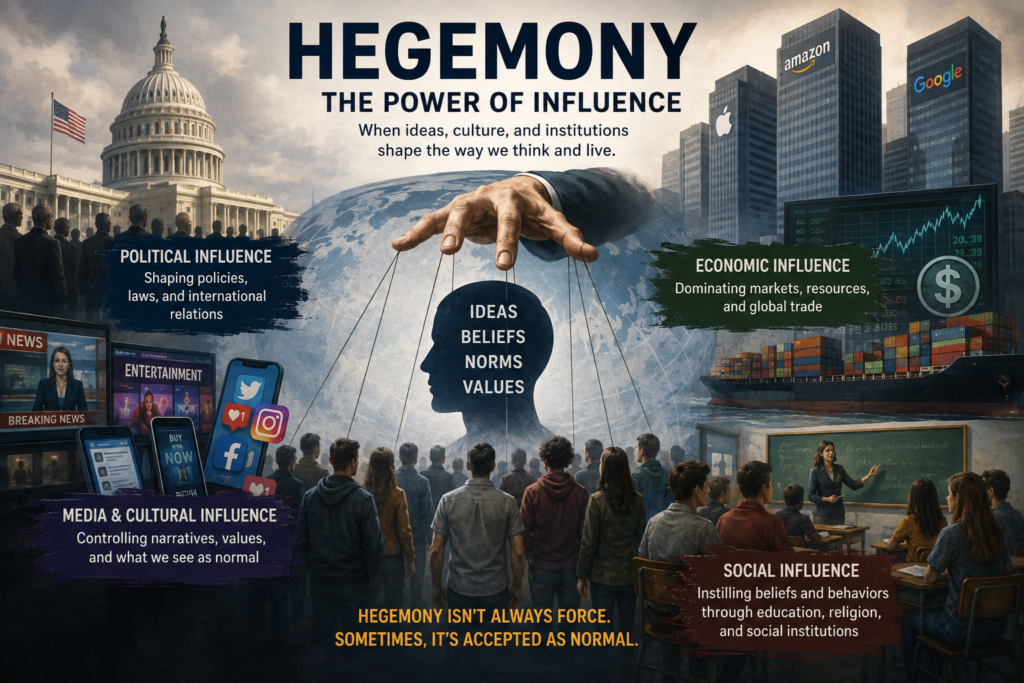
In simple terms, hegemony means dominance or leadership by one group over others, especially when that influence extends beyond direct force.
The interesting part is that hegemony does not always depend on threats or physical control. Sometimes people follow a particular system because they believe it is natural, successful, desirable, or simply the way things should be.
That is what makes the concept so interesting.
For example, imagine a workplace where one particular way of doing things has been followed for years. Nobody officially says that employees have to use that method, but everyone follows it because “that’s how things are done.”
That is not necessarily full political hegemony, but it helps illustrate the basic idea of influence becoming accepted as normal.
Hegemony in Everyday Life
When I first learned about hegemony, I made the mistake of thinking it was something that only applied to governments and international politics.
It is much broader than that.
Hegemonic influence can appear in:
- Politics
- International relations
- Education
- Media
- Business
- Popular culture
- Language
- Social institutions
- Technology
Sometimes we notice it immediately. Other times, it is so deeply embedded in everyday life that we hardly question it.
Cultural Hegemony
One of the most discussed forms is cultural hegemony.
The idea is strongly associated with Italian philosopher Antonio Gramsci, who explored how dominant groups can maintain influence not only through political or economic power, but also through culture and ideas.
Think about popular entertainment, advertising, fashion, language, or social expectations. Certain lifestyles can become widely presented as desirable or successful.
When those ideas become so common that people rarely question them, cultural influence can become extremely powerful.
I find this especially interesting because culture often feels harmless and ordinary. A movie, song, advertisement, or social trend may seem like simple entertainment, yet repeated messages can influence how people understand success, beauty, status, or even happiness.
Political Hegemony
Political hegemony is easier to recognize because it involves governments, states, and political institutions.
A powerful country may influence other countries through its military strength, economic importance, diplomatic relationships, international organizations, or political ideas.
However, political dominance does not always mean direct control.
A country can have enormous influence simply because other nations depend on its economy, technology, security partnerships, or international cooperation.
This is one reason power dynamics are so important when studying international relations.
A nation does not necessarily have to control another country directly to shape its decisions.
Economic Hegemony
Money creates influence too.
An economically powerful country, company, or institution may have the ability to influence markets, industries, policies, and consumer behavior.
For example, imagine a company becoming so dominant in a particular industry that competitors have difficulty challenging it. Its products become familiar, its systems become widely adopted, and other businesses begin building their own operations around it.
Eventually, the company’s influence goes beyond simply selling products.
Its standards may become industry standards.
Its methods may become common practice.
Its decisions may affect businesses that are not even directly connected to it.
This is where economic dominance can overlap with broader forms of hegemony.
Why Hegemony Does Not Always Look Like Force
This is probably the most important thing I learned about the concept.
When we hear words like “dominance” or “control,” we often imagine someone forcing another person to do something.
Hegemony can work differently.
Sometimes people willingly participate in a system because they believe it is reasonable or beneficial.
That does not mean they are being manipulated every second. Instead, the dominant ideas become part of the background of everyday life.
A useful way to think about it is this:
- A powerful group promotes certain ideas or practices.
- Those ideas become widespread.
- Institutions and culture reinforce them.
- People begin to see them as normal.
- The system becomes easier to maintain.
That process can happen gradually.
Hegemony vs. Simple Power
I used to think that hegemony and power were basically the same thing. They are related, but they are not identical.
Power is the ability to influence or control outcomes.
Hegemony goes a step further because it often involves establishing a dominant position that becomes widely accepted.
For example, a manager has formal authority over employees. That is power.
But if the manager’s preferred approach becomes the accepted standard throughout the organization, even when the manager is not present, we can start thinking about something closer to hegemonic influence.
The distinction may seem small, but it makes a big difference when analyzing society.
My Personal Tip for Understanding Hegemony
When I come across a complicated concept like this, I try not to memorize a dictionary definition first.
Instead, I ask three questions:
- Who has the most influence?
- Why do other people accept that influence?
- What ideas or systems help maintain it?
These questions make hegemony much easier to understand.
My second tip is to look for examples in ordinary life before jumping into complicated political theories. Think about social media, advertising, workplace culture, education, or entertainment.
Once you recognize the pattern in familiar situations, the academic definition becomes much easier to understand.
Hegemony and the Media
Media is another area where hegemony can become particularly interesting.
News organizations, entertainment companies, social media platforms, and advertisers all influence what people see and discuss.
Of course, media influence does not automatically mean that every message is designed to control people. That would be far too simplistic.
The more useful question is which voices receive the most attention and which perspectives receive less.
If certain viewpoints dominate public discussion for a long period, they can shape what people consider important, reasonable, or even possible.
This is sometimes described through the concept of ideological influence.
Why Hegemony Still Matters Today
You might wonder why we should care about a concept that sounds like something from a political science class.
I think the answer is simple: influence is everywhere.
We live in a world where information travels incredibly quickly. Companies compete for our attention. Countries compete for influence. Social platforms shape conversations. Cultural trends can spread across borders within hours.
Understanding hegemony gives us a useful way to step back and ask questions about these processes.
Instead of automatically accepting something as normal, we can ask why it became normal in the first place.
That does not mean we should reject every popular idea.
It simply means we should be willing to think critically.
How to Recognize Hegemonic Influence
You do not need to be a political scientist to recognize patterns of dominance.
When I am trying to understand whether something has a hegemonic quality, I look for a few things:
- Who benefits from the current system?
- Which ideas are treated as normal?
- Which voices receive the most attention?
- Are alternative perspectives taken seriously?
- What institutions reinforce the dominant position?
- Why do people continue accepting the system?
These questions can be useful in everything from international politics to workplace culture.
They also encourage us to look beyond obvious forms of authority.
Hegemony Is More Complicated Than It First Appears
One reason I like this concept is that it encourages a more careful understanding of power.
The strongest person in a room is not always the most influential person.
The loudest voice is not necessarily the most powerful one either.
Sometimes influence belongs to whoever controls the rules, sets expectations, shapes the conversation, or establishes what everyone else considers normal.
That is where social power becomes particularly important.
Hegemony can exist quietly. It can operate through habits, expectations, institutions, language, and culture.
And because it can feel ordinary, it is sometimes difficult to notice.
Final Thoughts on Hegemony
When I first encountered the word hegemony, I thought it was another complicated academic term that would take pages of reading to understand.
Now I see it differently.
At its simplest, hegemony is about dominant influence and how that influence becomes accepted or normalized. It can involve countries, political groups, economic institutions, cultures, media, or even everyday social expectations.
The concept is useful because it encourages us to look beneath the surface.
Instead of asking only who has power, we can ask why that power is accepted, how it is maintained, and which ideas support it.
For me, that is the most valuable lesson.
The next time you notice one idea, company, culture, or institution having an unusually strong influence, take a moment to ask yourself why. You might discover that there is much more happening beneath the surface than you first realized.
Quick Summary
Hegemony refers to a form of dominant influence in which one group, country, culture, or set of ideas holds a leading position. It can involve political power, economic influence, cultural norms, or ideological control.
Understanding hegemony does not mean questioning everything. It simply gives us another useful lens for understanding power structures, social influence, and the world around us.
What is your understanding of hegemony? Have you noticed an example of it in politics, culture, media, education, or everyday life? Share your thoughts in the comments and join the conversation.