
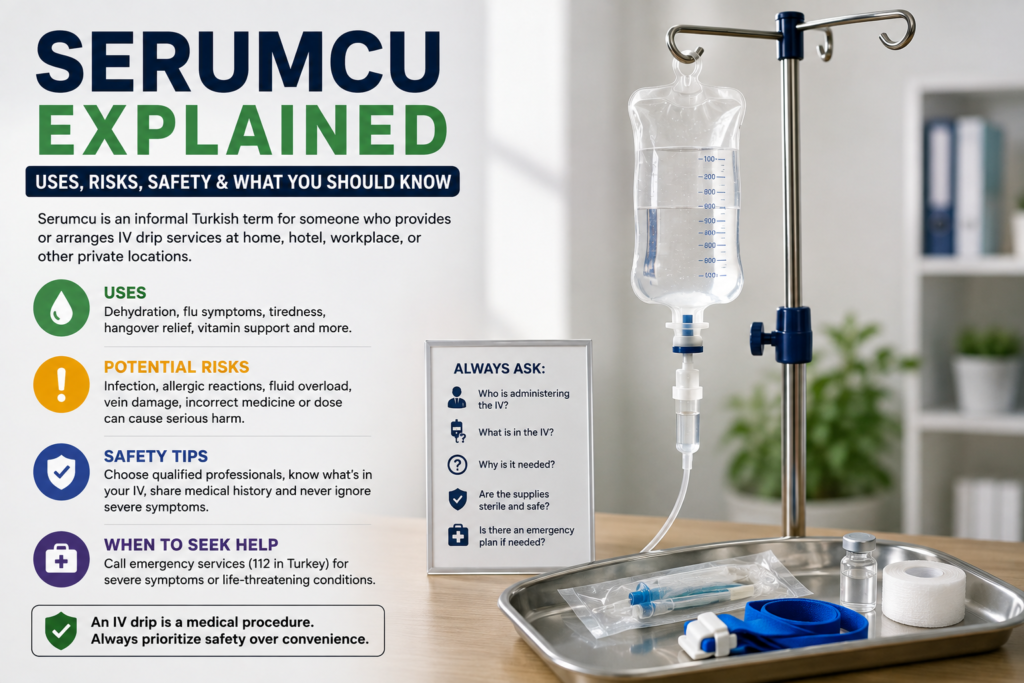
I first came across the word serumcu while looking into the growing popularity of mobile healthcare services in Turkey. At first, the term sounded like it might describe a specific medical profession. It turns out that it is a little more complicated than that.
Imagine feeling exhausted after several days of illness. You are dehydrated, have barely eaten, and do not really feel like leaving your home. Then someone offers to send a healthcare worker to your house to give you an IV drip. It sounds convenient, especially when you are feeling miserable.
But convenience should never be confused with safety.
A serumcu service can involve intravenous fluids, medicines, or other substances delivered directly into a vein. Because an IV goes straight into the bloodstream, the treatment deserves proper medical attention, qualified professionals, and careful assessment.
So, what exactly does serumcu mean, and what should someone know before considering an IV drip service?
What Does Serumcu Mean?
Serumcu is an informal Turkish expression associated with someone who provides or arranges an intravenous drip.
The word is related to “serum,” a commonly used Turkish term for an IV fluid bag. The ending “-cu” can describe someone connected with a particular product, activity, or service.
One important point often gets overlooked, though. Serumcu is not itself a medical qualification.
Someone calling themselves a serumcu is not automatically a doctor, nurse, or licensed healthcare professional. The person’s actual professional credentials are much more important than the label used to advertise the service.
This distinction is worth remembering, particularly when services are advertised through websites, messaging apps, or social media.
How Does a Serumcu Service Usually Work?
The process can look quite simple from the outside.
A person contacts an IV service and explains what they are experiencing. Depending on the provider, the service may then send a healthcare professional to a home, hotel, office, or another private location.
The healthcare worker may assess the person’s condition before starting treatment.
If an IV is considered appropriate, a small cannula is inserted into a vein, usually in the hand or arm. The cannula is connected to an IV line, which delivers fluid into the bloodstream.
The actual contents of the drip can vary considerably.
Some treatments may involve basic fluids, while others may include vitamins, minerals, or prescription medicines. This is why asking exactly what is being administered is so important.
A colorful bag or attractive package name does not tell you whether a treatment is appropriate for your particular situation.
Why Are IV Drips So Popular?
There is an obvious reason these services appeal to people: convenience.
When someone feels sick or extremely tired, travelling to a clinic may feel like a huge effort. A mobile service brings treatment directly to the person.
I can understand why that sounds attractive. However, an IV treatment is still a medical procedure even when it takes place in a comfortable bedroom or hotel room.
Social media has also played a role in making IV therapy look simple and routine. Some services promote drips for energy, immunity, recovery, dehydration, or hangovers.
The presentation can make the treatment appear almost like a wellness experience.
That is where I think people need to slow down and ask a few basic questions.
What is actually in the IV?
Why is it needed?
Who prescribed or approved it?
Is the person administering it properly qualified?
Those questions are much more important than how appealing the package looks.
What Can Be Inside an IV Drip?
There is no universal serumcu formula.
The contents depend on the purpose of the treatment and the provider’s medical plan. Depending on the situation, an IV may contain fluids or prescribed medicines.
Some ingredients that may be used in different IV treatments include:
- Sodium chloride solution
- Glucose-containing fluids
- Certain vitamins
- Electrolytes
- Anti-nausea medication
- Pain-relieving medication
- Other prescribed medicines
The important thing is that these substances should not simply be mixed together because someone wants a stronger or faster treatment.
Every ingredient can have its own effects, contraindications, and possible interactions.
For that reason, I would always want to know exactly what is going into an IV before agreeing to treatment.
What About “Yellow Serum” or “Atom Serum”?
You may come across terms such as sarı serum, often translated as yellow serum, or atom serum when researching IV treatments in Turkey.
These names can sound as though they describe standardized medical treatments. In reality, the contents can vary between providers and preparations.
That matters because different ingredients can produce different effects and risks.
A patient should not assume that a treatment is safe simply because it has a popular name. The actual substances, doses, medical reason, and patient’s health condition are what matter.
This is particularly important for people with allergies or existing medical conditions.
Can Serumcu IV Treatment Cure the Flu?
This is one area where expectations need to be realistic.
An IV drip is not automatically a treatment for influenza or other viral respiratory infections.
If someone is dehydrated because they have been vomiting, experiencing diarrhea, or struggling to drink enough, medical professionals may decide that intravenous fluids are appropriate.
But giving someone fluid through a vein does not magically eliminate a virus.
The same principle applies to antibiotics. Antibiotics are designed to treat certain bacterial infections, not ordinary viral illnesses such as most colds and cases of influenza.
If someone has a high fever, difficulty breathing, severe weakness, confusion, chest pain, or symptoms that are getting worse, proper medical evaluation is more important than simply requesting an IV.
Can Serumcu Help With Tiredness?
Tiredness is one of those symptoms that can have many explanations.
Maybe someone has not slept properly. Perhaps they are dehydrated. They could be recovering from an infection, dealing with stress, or experiencing another underlying problem.
An IV might help if dehydration is genuinely contributing to the person’s symptoms. But that does not mean an IV is a universal energy booster.
This is one of my biggest takeaways when looking at IV wellness services: treat the reason for the symptom, not just the symptom itself.
If someone repeatedly feels exhausted, getting an infusion every time may provide temporary reassurance while the actual cause remains unexplored.
Persistent or unexplained fatigue deserves proper medical attention.
What About Hangover IV Treatments?
Hangover IV services have become particularly popular because they promise quick relief from symptoms such as thirst, headache, nausea, and weakness.
Fluids can help address dehydration in appropriate circumstances, but an IV does not instantly remove alcohol from the body.
There is another issue that should not be ignored. Some hangover treatments may contain medications, and those medicines are not automatically suitable for every person.
Someone with an existing medical condition, medication use, or allergy may face additional risks.
If a person is difficult to wake, unconscious, having seizures, breathing unusually slowly, or showing signs of severe alcohol poisoning, a routine IV appointment is not the appropriate response. That situation requires emergency medical care.
What Are the Risks of Serumcu Treatment?
It is easy to think of an IV as harmless because hospitals use them every day.
But IV treatment is still invasive.
The skin is pierced, a foreign device enters a vein, and substances are delivered directly into the bloodstream. Problems can occur if the procedure, equipment, medication, or patient assessment is inappropriate.
Infection
Poor hygiene or contaminated equipment can introduce bacteria and potentially cause an infection.
This is one reason sterile, single-use equipment and proper technique are so important.
Allergic Reactions
An ingredient added to an IV can cause an allergic reaction.
Symptoms can range from itching and skin reactions to swelling, breathing difficulties, low blood pressure, and potentially life-threatening anaphylaxis.
Vein Irritation
The vein can become irritated after an IV is inserted. Bruising, swelling, discomfort, inflammation, or leakage of fluid into surrounding tissue can occur.
Medication Errors
Giving the wrong medicine, incorrect dose, unsuitable combination, or inappropriate infusion rate can cause serious problems.
This is why a proper medical assessment should come before treatment.
Too Much Fluid
Certain patients may be more vulnerable to fluid-related complications, particularly people with some heart, kidney, or liver conditions.
More fluid is not necessarily better.
How Can You Check Whether a Serumcu Service Is Safe?
If someone is considering a mobile IV service, I would not start by looking at the package price.
I would start with the provider.
Here are some questions worth asking:
- Who will administer the IV?
- What are their professional qualifications?
- Who has assessed or prescribed the treatment?
- What exactly is inside the IV?
- What doses are being used?
- Are the supplies sterile and single-use?
- What happens if an allergic reaction occurs?
- Is emergency equipment available if needed?
A trustworthy healthcare provider should be comfortable answering reasonable questions.
Be cautious if someone refuses to explain the ingredients, makes exaggerated promises, uses unidentified medicines, or offers exactly the same mixture to every customer regardless of their medical history.
When Is an IV Actually Appropriate?
IV therapy has legitimate medical uses.
Doctors may recommend intravenous fluids or medicines when someone cannot drink adequately, has significant dehydration, requires certain medications, has particular electrolyte problems, or needs treatment that is best delivered intravenously.
The key word here is appropriate.
An IV should be used because there is a medical reason for it, not simply because it seems stronger or faster than taking medicine by mouth.
That difference is easy to overlook when mobile IV services are advertised as convenient wellness solutions.
My Two Practical Tips Before Considering Serumcu
Tip 1: Ask for the ingredient list
Never be embarrassed to ask what is going into your body.
I would want the names and doses of the substances being administered, especially if medicines are involved.
If the provider cannot give a clear answer, that is a warning sign.
Tip 2: Tell the provider your complete medical history
Do not assume that a provider only needs to know your current symptoms.
Mention allergies, existing conditions, medications, pregnancy if applicable, and previous reactions to medicines or IV treatment.
Small details can make a significant difference when medication or intravenous fluids are involved.
When Should You Seek Emergency Care?
Some symptoms should never be handled by simply arranging a routine mobile IV appointment.
Seek urgent medical attention for symptoms such as:
- Severe difficulty breathing
- Chest pain
- Loss of consciousness
- Seizures
- Severe confusion
- Blue or grey lips
- Serious allergic swelling
- Rapid deterioration
- Extreme dehydration
- Severe symptoms following an IV infusion
An emergency situation needs emergency medical care.
A home IV service should not be treated as a replacement for an emergency department.
Final Thoughts on Serumcu
The word serumcu may sound straightforward, but the services associated with it can involve real medical procedures.
A mobile IV drip can certainly be convenient, and intravenous treatment has an important place in modern healthcare when it is medically appropriate.
At the same time, an IV should never be treated like an ordinary wellness product. The qualifications of the healthcare professional, the reason for treatment, the contents of the IV, sterile technique, dosing, and emergency preparedness all matter.
For me, the simplest way to look at serumcu services is this: convenience is useful, but medical safety comes first.
Before choosing an IV service, ask questions, understand what you are receiving, and make sure a qualified healthcare professional has determined that the treatment is appropriate.
If you have used a serumcu service or have questions about mobile IV treatment, share your experience or thoughts in the comments. Your experience may help someone else make a more informed decision.